Keyboards as a source of infection: US study finds dangerous pathogens on computer keyboards in hospitals

US study finds concerning germs on hospital keyboards
A study by the University of Seattle has produced worrying findings regarding the contamination of Dangerous germs on computer keyboards in hospitals and doctors’ surgeries concerns. The meta-analysis brings together 75 individual studies on the contamination of hospital equipment with germs, some of which are dangerous. Taken together, the individual studies covered the examination of 2,800 items of equipment, the majority of which were keyboards. The result: 97 per cent of keyboards are contaminated with germs. Not all of these germs are dangerous. However, what is alarming about this study is that a significant number of them are multi-drug-resistant. Methicillin-resistant Staphylococcus aureus (MRSA) was found on 28 per cent of the keyboards. On average, the researchers detected vancomycin-resistant bacteria on just under 4 per cent of all devices, and Clostridium difficile on 8 per cent. There were sometimes significant differences between the facilities: in some hospitals, hardly any bacteria were found, whilst in others, pathogenic bacteria were detected on practically every keyboard.

Alarming contamination levels despite simple disinfection methods being available
The meta-analysis has not yet been able to determine conclusively what impact this contamination actually has on nosocomial infections (hospital-acquired infections), as this was not investigated in all individual studies. Nor do all individual studies comment on the effectiveness of disinfection measures. Thus, it could only be demonstrated that the The bacterial count can be reduced using agents such as isopropanol, chlorhexidine or UV light can.
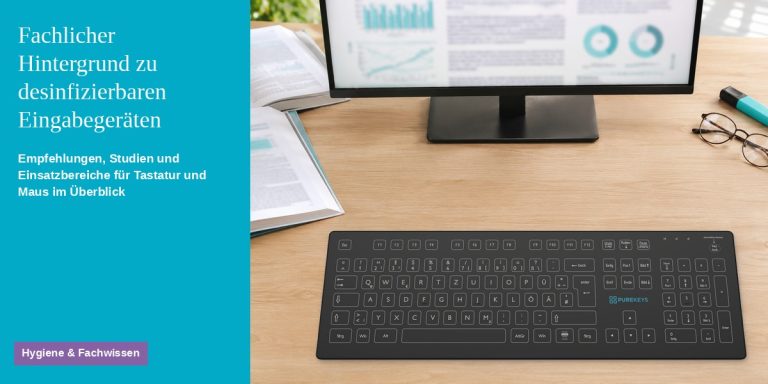
Stefan Ernst, Managing Director of Purekeys Germany: “More than a quarter of keyboards harbour potentially pathogenic germs – these are alarming figures! Given the technical capabilities we have today, this is simply unacceptable. We have been able to demonstrate that our keyboard clean from dirt and germs in seconds provided the disinfection is carried out correctly. The keyboard’s robustness also ensures that it continues to function reliably for years, even when disinfected several times a day.”
More people die from hospital-acquired infections than in road traffic accidents
Better hygiene in hospitals is also important because increasing resistance of germs in hospitals are increasingly becoming a global problem. It is not uncommon for a patient to die not from the illness for which they were admitted to hospital, but from one of the germs that can no longer be treated with many antibiotics. A feature on the Arte channel entitled “Resistance Fighters – The Global Antibiotic Crisis” draws attention to this issue. According to this documentary, around 700,000 people worldwide die each year from infections caused by multidrug-resistant or, in some cases, even pan-resistant bacteria.
Further links
Original study:
https://bmjopen.bmj.com/content/9/3/e026437
ZSummaries:
https://www.zwp-online.info/zwpnews/dental-news/wissenschaft-und-forschung/keimschleuder-tastatur-auf-jeder-siebten-sind-resistente-keime
https://www.aerztezeitung.de/medizin/krankheiten/infektionskrankheiten/hygiene/article/983256/unterschaetzte-infektionsquellen-fast-alle-computertastaturen-verkeimt.html
Summary of the feature:
https://programm.ard.de/TV/arte/resistance-fighters/eid_287243117601584
Watch the feature:
https://www.youtube.com/watch?v=CBRFrPQ8iuM